Implementing AI in your business means changing how some of your work gets done. That change is where most businesses stall: they buy the tools, but the way the work happens stays the same. The businesses that succeed treat adoption as an operating decision and work through it in order.
Budget, industry, and technical talent matter less than people expect. In our client work, and in the research on why AI efforts fail, it comes down to four decisions:
- What is the AI for?
- Which process makes room for it?
- Who gets trained past the basics?
- What gets measured?
We have guided businesses through AI since before most had an opinion on it. This guide walks through how to implement AI in your business: where it belongs, what must come first, and how to make it stick.
- AI is no longer optional for established businesses; adoption nearly doubled in a year, and the gap between adopters and waiters keeps widening.
- Most AI efforts stall because firms buy the tools and never change how the work gets done.
- Adoption is finished when AI sits inside daily workflows, owned by the team, and measured against a baseline.
- Start where AI fits: repeatable, document-heavy work first. Prove one narrow use case, measure from day one, then extend.
- Training decides whether adoption sticks. Teams that never learn to use AI well quietly abandon it.
Where Are We in the AI Shift, and Why Is It No Longer Optional?
We are further into the AI shift than most business owners realize, and the rate of change is still climbing. Consider how far this moved in under four years.
In late 2022, AI was a chatbot that could draft a decent paragraph and often got the facts wrong. Today it reasons through multi-step problems, reads contracts, analyzes spreadsheets, holds a natural voice conversation, and produces work that passes professional review. Few technologies a business relies on have moved this fast.
Major capability jumps now arrive within weeks. Work that required a specialist and a budget three years ago now sits inside a $20 monthly subscription. Standard tools now do what premium models did a year ago. Businesses that planned around AI’s limitations keep discovering the limitations are gone.
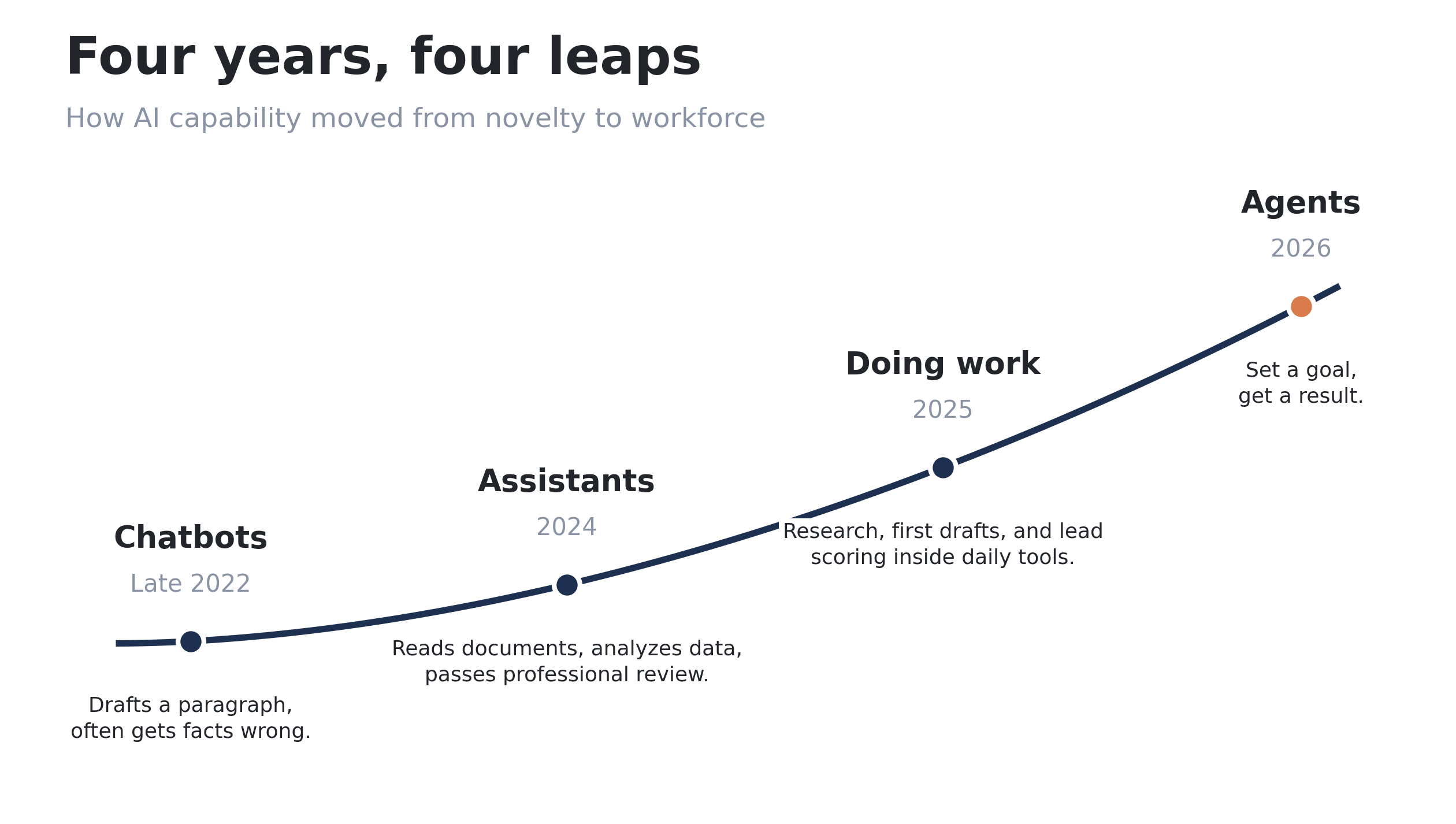
From Answering Questions to Doing Work
That evolution changed the role AI plays in a business. Today it:
- Writes first drafts and summarizes documents
- Runs research in minutes that took days
- Scores leads and answers routine client questions
The newest step is agentic AI: instead of asking a question and getting an answer, you set a goal and get a result. Agents that plan and carry out multi-step work are arriving in mainstream tools now.
Businesses are adopting as fast as the capability grows. In professional services, the Thomson Reuters Institute found organization-wide AI use nearly doubled, from 22 percent in 2025 to 40 percent in 2026. Your competitors and your clients are part of those numbers.
What the Current Rate Means for You
At this rate, the next few years are easy to predict. AI will keep taking over the repeatable layer of business work. It will keep showing up inside the software you already own, whether you plan for it or not.
Nobody can predict the tools of 2028. The businesses that benefit will be the ones that learned how to adopt: find the fit, prove the value, and train their people.
The vendors will keep improving the tools. Learning to adopt them well is your side of the work. Treating AI as a nice-to-have made sense in the experimental years, and those years are over. Waiting puts you further behind businesses that are already learning.
Why Do Most AI Efforts Stall?
Most AI efforts stall because the business treats adoption as a purchase instead of a change in how it operates. The pattern repeats across industries.
A firm buys licenses. One or two enthusiasts experiment. A few impressive demos make the rounds. Then nothing about the daily work changes, interest fades, and six months later the subscription quietly lapses.
It happens more often than most leaders expect. Gartner projected that at least 30 percent of generative AI projects would be abandoned after proof of concept, before ever reaching production.
The reasons behind numbers like that are rarely technical. The tools work. What fails is everything around them:
- No one decided what the AI was for
- No process changed to make room for it
- No one was trained past the basics
- No one measured whether it helped
The stall is organizational, not technological. That is good news, because organizational problems can be fixed, and fixing them is what the rest of this guide covers.
What Does Adopting AI Mean in Practice?
AI is adopted when it is part of how your business runs, not an experiment beside it. Using AI tools and having adopted AI look similar from a distance, and they produce completely different results.
| Using AI tools | Having adopted AI |
|---|---|
| A few people experiment when they think of it | AI sits inside the workflows the business runs on |
| Results depend on who happens to be prompting | Results are consistent because the process carries the method, not the person |
| No one measures anything | Value is measured against a baseline set on day one |
| The capability leaves when the enthusiast does | The capability is trained, shared, and owned by the team |
| AI is a line item on the software budget | AI is part of how the work gets done |
“AI is adopted when it is part of how your business runs, not an experiment beside it.”
Where Does AI Belong in Your Business, and Where Does It Not?
AI belongs where the work is repeatable, document-heavy, and high-volume. It does not belong where judgment, relationships, and accountability carry the value. Learning to see that fit in your own business is the first skill of adoption.
The same judgment applies to autonomy. AI can answer a question, run a fixed workflow, assist alongside a person, or pursue a goal on its own as an agent. Match the level to the work, and give a task more autonomy once it proves stable.
Here is what that looks like in practice. A research brief the AI drafts and a person edits sits at the assistant level. After months of consistent quality, the same brief can run as a workflow, with review at the end instead of hands on the keyboard.
How to Spot the Work AI Improves Most
Run every candidate task through three questions. Does it repeat weekly in roughly the same shape? Does it start from documents, data, or questions answered before? Would you trust a capable new hire with the first pass?
If the answer is yes three times, AI improves that work. In an established firm, the same work shows up again and again:
- Intake summaries and first drafts of routine documents
- Meeting notes turned into action items, and research briefs
- The client questions your team answers for the tenth time each month
- Competitive research, which we run with generative AI and documented step by step in our competitive analysis guide
In professional services firms, this work absorbs a surprising share of senior time, which is exactly why it pays first. AI drafts, summarizes, sorts, and finds. It gives your experienced people back the hours that repetitive work takes from them.
The Work That Should Stay Human
The judgment that makes your firm worth hiring stays human: the advice, the strategy, the final word on anything that carries your name. So do relationships. Clients hire people they trust, and they build that trust in conversations with people. And accountability cannot be delegated to software; when AI drafts, a qualified person reviews, because the firm owns every output either way.
Businesses that respect this line get the best of both: AI carries the volume, people carry the judgment. Businesses that ignore it in either direction, automating the judgment or hand-carrying the volume, leave value on the table.
What Has to Be True Before AI Creates Value?
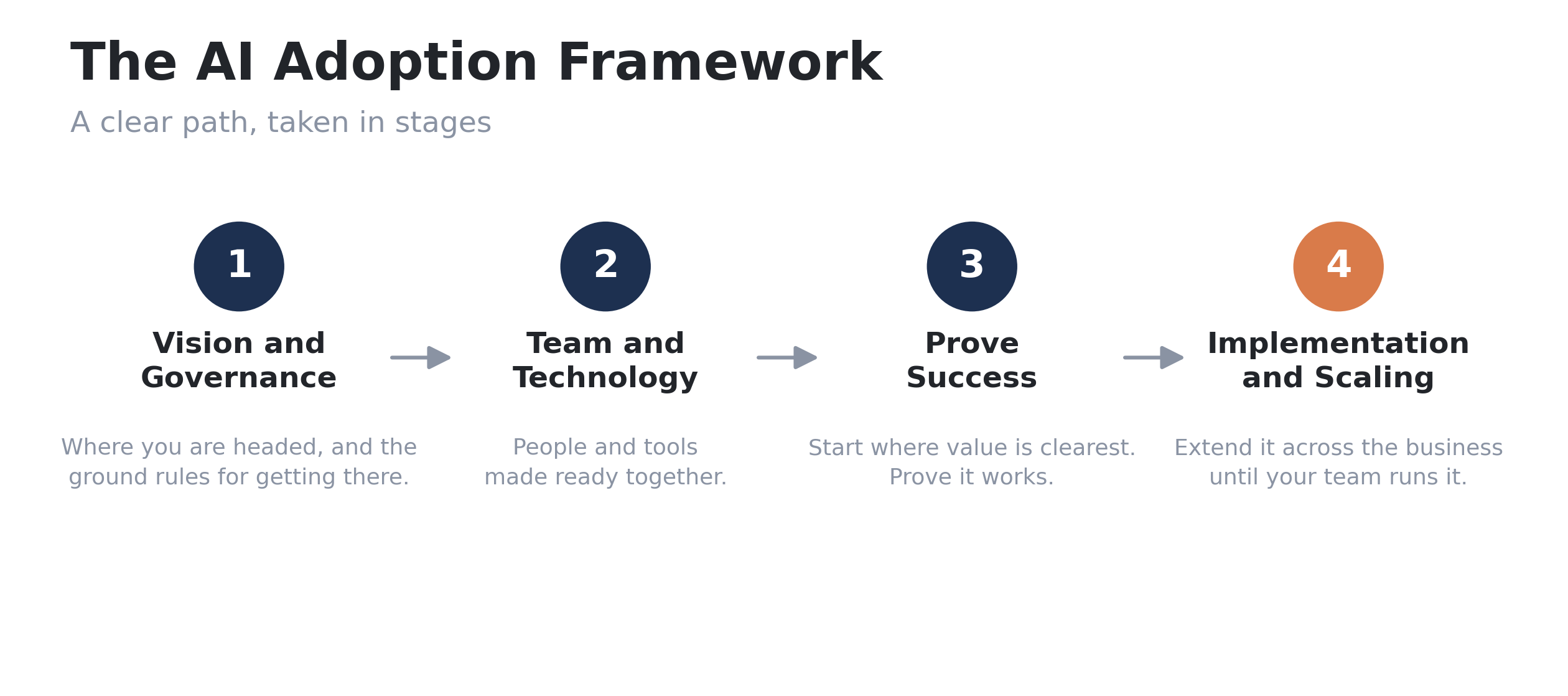
Three things have to be true before AI creates value in an established business. Your people are ready, your process is clear, and your ground rules are set. Skipping these is how firms end up with impressive tools and no results. This readiness work is Phases 1 and 2 of our AI Adoption Framework, and it comes before any tool decision on purpose.
People Readiness
Leadership owns the effort and the team knows why it is happening. AI adoption announced by memo fails.
People need to hear what it means for their work, what it does not mean, and what they will learn. A short, honest readiness conversation surfaces the gaps early, while they are cheap to fix. WSI’s AI Readiness Assessment gives that conversation structure.
Process Clarity
You can describe the work before you hand any of it to AI. You cannot improve a process you cannot describe. If your intake, reporting, or content workflow lives in three people’s heads in three different versions, the fix comes before the tool.
Ground Rules
Everyone knows what data may go into which tools, what gets disclosed to clients, and what gets human review before it ships. This does not require a governance department. A one-page policy, taken seriously, prevents most of the trouble. Clean inputs and clear ownership make data-driven marketing work, and the same discipline applies here.
What the Readiness Discipline Is Worth
The discipline pays. Thomson Reuters’ Future of Professionals research links a visible AI strategy to a 3.5 times higher likelihood of measurable ROI. The same research puts the gain at about 5 hours per professional per week, worth roughly $19,000 per person per year.
One caution most guides skip: if your firm bills by the hour, those 5 saved hours per person are hours you no longer bill. The gain appears only when something else changes: the hours move to higher-value work, capacity takes on new clients, or you change how you price. The firms that win with AI decide in advance where the recovered time goes. Decide that in the plan, before the rollout starts.
Handled well, the numbers move the right way. A Stanford and MIT study of 79 small and midsize accounting firms found AI users moved about 3.5 hours a week into higher-value work. The same accountants reported 21 percent higher billable hours.
Why Should Your First AI Use Case Be Narrow?
Your first use case should be narrow because it proves the method, and the method is what scales. Pick one workflow where the fit is clearest, define what better looks like, and measure from day one. Track hours saved, turnaround time, and output quality against a baseline you record before you start.
The baseline does not need software. Before you start, write down how long the task takes today, how many go through per week, and what a good result looks like. Those three numbers are the whole scoreboard.
A narrow start does three things a broad rollout cannot:
- It produces evidence instead of impressions, so the decision to expand is a business decision.
- It gives your team a contained place to build skill and confidence.
- It keeps the cost of being wrong small, because some first guesses are wrong, and finding that out on one workflow is cheap.
This pattern shows up wherever adoption is done well. The Journal of Accountancy documented one example at Eventus Advisory Group, a financial advisory firm. The firm pointed AI at a single task, drafting technical accounting memos, with every memo reviewed by a person. That task went from four hours to 30 minutes, and only after it worked did the firm build its next use case.
How We Apply This in Our Own Business
We follow this rule in our own business. When we rebuilt our content operation around AI, we did not hand it everything. We gave it one job at a time inside a gated process, with AI as the assistant and our team holding every judgment call.
The split became clear fast. AI is best at the depth work: research that runs wider than we ever had time for, first drafts, and applying our standards consistently. The human in the loop is best where judgment lives: the angle, the taste, and the final call on what sounds like us.
Work that once took a week of hands-on hours now takes a fraction of that time, and the quality bar rose. This guide was produced that way: AI did the heavy lifting, and the direction, the standards, and the final word stayed with us. We now apply the same method across our client engagements: find the fit, start narrow, measure, and keep the judgment human.
Once the first use case works, do not expand on excitement. Expand when the numbers say it worked. That is the whole point of starting small.
How Does AI Become Part of How You Run?
AI becomes part of how you run when someone inside the firm owns it, the team is trained past the basics, and expansion follows proof. This is where adoption succeeds or falls apart, and training usually decides it.
Ownership Comes First
Someone accountable inside the business, not a vendor, decides what expands, what gets retired, and what gets measured. Without an owner, every AI effort is temporary.
Training Makes Adoption Stick
Most teams never learn to use AI well, and untrained teams stop using it. Real capability comes from hands-on practice with your firm’s own workflows, reinforced over time.
That conviction is why we built the AI Academy. It is live, practitioner-led training that starts at your team’s current skill level and runs through building custom tools. Office hours reinforce the learning so it sticks.
Expansion Follows Proof
The second and third use cases go faster than the first because the method is established: find the fit, set the baseline, measure, decide. Keep measuring even after it works. Tools change fast; the discipline is what lasts.
Should You Buy Tools, Build Custom, or Bring In Help?
For most established businesses, the answer is to buy rather than build, and to bring in help when it saves you time and expensive mistakes.
Today’s off-the-shelf tools cover the common use cases well. Configuring them gets you most of what custom development promises, at a much lower cost and risk. Custom builds make sense only when a workflow is central to your business and no available tool handles it. That happens less often than vendors suggest.
Whether to bring in outside help is a judgment call, and the criteria are concrete. If your team can find the fit, set ground rules, and run a measured pilot on its own, you do not need a consultant. This guide is most of the map. Help pays for itself in three cases:
- New territory your team has not worked in before
- A first attempt that already stalled
- Senior people with no time to lead the effort
Those are the same reasons firms bring in fractional marketing leadership rather than learning through expensive trial and error. What to look for in either case: someone who starts with your business problem instead of their tool list, and commits to measurable results.
Frequently Asked Questions About Implementing AI in Your Business
How much does it cost to implement AI in a small business?
The real cost of implementing AI is the adoption work. Tools are the smallest line. What you invest in is readiness, training, and the time to prove a use case and measure it.
The cost drivers are how clear your processes are, how ready your people are, and how many workflows you take on at once. A narrow, measured start keeps the investment small and tied to evidence. The expensive path is a broad rollout with no owner, no training, and no measurement, which spends months of attention and returns nothing.
How long does AI adoption take?
A first narrow use case can show measurable results in four to eight weeks. Meaningful adoption, where AI is trained into the team and running inside several workflows, typically takes three to nine months in an established business. The timeline depends less on the technology than on readiness. Firms with clear processes and engaged leadership move fast; firms that skip readiness spend the same months stalling.
Is AI worth it for a small business?
Yes, when it is tied to a specific problem and measured, and no, when it is adopted because of pressure to seem current. Research from the National Bureau of Economic Research shows the largest gains land on repetitive, high-volume work and on less experienced staff.
For a small business, that translates to hours recovered every week. The return depends on fit and follow-through. The worth-it question is best answered by a narrow, measured pilot rather than a leap of faith.
Will AI replace my employees?
In most established businesses, AI changes tasks rather than replacing people. It takes on the repetitive layer: drafting, summarizing, sorting, and answering routine questions.
That shift moves people toward judgment, relationships, and oversight. Research consistently shows the biggest AI productivity gains go to newer employees, which makes it a leveler inside a team. The businesses that get this right pair adoption with training, so people grow into the higher-value work rather than fearing the change.
What AI tools should a small business start with?
Start with the problem you want solved. Identify the most repetitive, time-consuming workflow in your business, then choose the tool category that fits it.
Options include a general assistant for drafting and research, a meeting tool for notes, or a service tool for routine customer questions. The AI already built into the software you use today counts too. The tool matters less than the fit, the baseline you measure against, and the training behind it.