Intelligent lead generation is about spending scarce sales time on better opportunities. It connects what you know about your best clients with what prospects are doing now, then checks those assumptions against what actually becomes good business. AI can help surface patterns, but the team still decides what matters and what to do next.
Most firms can tell you how many leads they generated last month. Far fewer can tell you how many were plausible clients, why the strongest ones moved forward, or how much senior time went to leads that never fit. Intelligent lead generation is meant to make those decisions less wasteful and more informed.
Key Takeaways
- Intelligent lead generation helps a small team recognize better-fit prospects earlier and focus attention where it is most likely to matter.
- Buyers often do substantial research before contacting a firm, so the system has to work before a lead appears in the CRM.
- AI can help surface patterns that people cannot reasonably track by hand. It is useful when it improves judgment, not when it pretends to replace it.
- The journey continues after the sale. Client results, referrals, and reviews help the team refine what a good lead looks like and where new business is coming from.
Lead Quality Decides Growth
A good lead fits the work your firm wants, arrives with useful context, and has a real reason to keep moving. A bad lead creates activity with little chance of becoming good business. In many B2B and professional services firms, the owner or senior staff still handle sales. Every poor-fit inquiry uses some of the most expensive time in the business.
When I review lead generation for a professional services firm, lead volume is rarely the first number I want to see. I want to know how many inquiries were plausible clients and what happened to them next. I also want to know how much senior time went to people who never fit in the first place.
The 2025 B2B Buyer Experience Report found that first contact happened about 61 percent of the way through the buying journey. The winning vendor was already on the buyer’s Day One shortlist 95 percent of the time.
By the time someone contacts your firm, much of the decision may already be taking shape. The leads worth the most are the ones that fit your business and arrive with enough understanding to have a useful conversation. A system that produces ten of those beats a campaign that produces a hundred names. Your team can pursue ten prospects well. Nobody pursues a hundred well.
What Makes Lead Generation Intelligent
A lead system becomes more useful when it can connect three things that are often separated: who tends to become a good client, what a prospect is doing now, and what happened after the team responded. That connection gives marketing and sales a better basis for deciding where to spend time.
AI is useful when the volume of behavior is too much for a person to follow reliably. It can flag patterns or changes worth reviewing. It cannot tell us why a buyer acted that way. Clear fit criteria and human judgment still matter. This business-first approach is part of our AI consulting work.
The difference is easiest to see in what each approach rewards.
| Factor | Volume Approach | Intelligent Approach |
|---|---|---|
| Goal | More inquiries | Better-fit prospects, recognized early |
| Measures | Lead counts, form fills | Fit rate, progression, cost per client won |
| A Good Month | The list grew | Real conversations with right-fit buyers |
| Main Cost | Ad spend and outreach volume | Senior time protected, spent only where it counts |
How the System Works in Practice
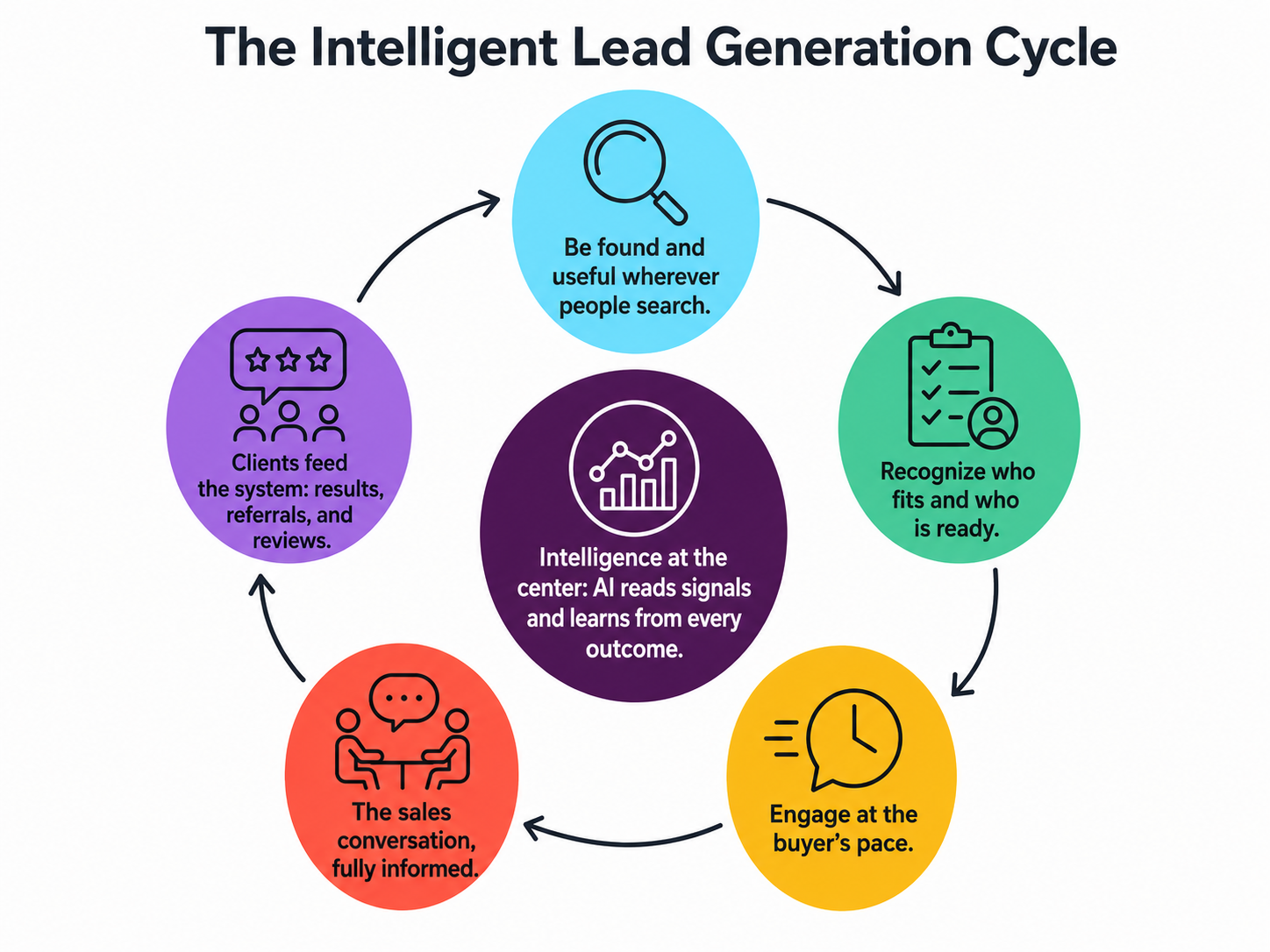
In practice, the system keeps cycling through four jobs: identify fit, interpret behavior, stay useful while the buyer decides, and learn from the outcome. The technology can support each job, but the business rules come first. This is how we approach lead generation and conversion as a connected system rather than a collection of campaigns.
Lead Scoring Helps Prioritize Fit and Engagement
A pricing-page visit means very little by itself. Now imagine a company that fits your target market returns several times, reads implementation material, and sends a second person to a case study. You still do not know that they are ready to buy. You do have a stronger reason to look at the account and decide whether useful outreach makes sense.
Some teams can do this with tools they already own. HubSpot’s lead-scoring documentation is one example of a platform that separates fit and engagement scoring for contacts and companies. The important question is whether your team has criteria and data good enough to make the score useful. A simpler model people understand is better than a sophisticated score nobody trusts.
The score should help organize attention, not make the decision for your team. A high score is a reason to look closer. Sales still needs to decide whether the account fits, whether the behavior makes sense, and whether outreach would be useful now.
Personalization Should Build on What the Buyer Already Knows
A buyer who read one introductory article should not get the same follow-up as someone who returned to implementation content and shared a case study internally. Good personalization starts with what the buyer already knows and avoids making them begin again.
Technology can help preserve that history so the next person on your team does not have to reconstruct it. The message still has to sound like your firm and make sense for the buyer. Repeating tracked behavior back to someone or guessing too much about their intent is not personalization. It is creepy.
Nurturing Stays Useful While the Buyer Decides
Many good prospects are not ready to talk when they first find you. Staying useful might mean answering an implementation question today and giving them proof they can share internally a month later. The point is to help the decision move, not to keep the automation busy. That is where strong content marketing earns its place in the system.
The standard for every touch is that the prospect is glad it arrived. Anything that exists only to stay visible teaches buyers to ignore you.
Measurement Shows Which Leads Became Good Business
A dashboard should make one uncomfortable comparison easy to see: which sources produce activity, and which produce clients. Forty inexpensive inquiries with no wins can look efficient until you count the sales time they consumed. Eight well-fit conversations and two new clients tell a very different story.
Then feed the outcome back into the system. Which prospects became strong clients? Which never fit? Which stalled for reasons the marketing team could have addressed? Those answers should change how the team scores and follows up next time.
Before a Lead Appears, the Buyer Is Already Learning
A buyer may know your name before your CRM knows theirs. They might first encounter you in Google, an AI answer, a LinkedIn discussion, a peer recommendation, or content someone forwarded. You do not need to chase every channel. You do need to understand where your best buyers actually research and what they need when they find you.
Being present is only the start. Buyers doing their own research need enough substance to judge how you think and whether your firm belongs on the shortlist. Useful content should answer real questions before the buyer is ready to give you their contact information.
AI is one part of that research mix. Gartner reported in May 2026 that buyers used an average of seven information sources in a recent purchase. Forty-five percent used generative AI, and 69 percent preferred to validate AI-generated insights with a sales representative. The first conversation should add what research cannot: context, judgment, and help with the parts of the decision that are still uncertain.
A Better Lead Creates a Better First Conversation
When the system works, the first conversation does not begin with two strangers exchanging basic facts. The buyer already has some sense of how your firm thinks. Your team has enough context to ask better questions instead of starting from zero.
That is a useful test of the whole system. If good prospects arrive better informed and your team can get to the real situation faster, the work before the meeting is doing its job.
The System Keeps Working After the Lead Becomes a Client
The journey does not end when a lead becomes a client. Strong client outcomes should change how the firm thinks about fit. Which engagements became strong relationships? Which projects were profitable, repeatable, and a good match for the team? Those answers belong in the next round of targeting and qualification.
Strong clients often tell you where the next good opportunities will come from. Their referrals, reviews, repeat work, and introductions reveal what trust looks like after the sale. Learn from those relationships instead of treating the signed contract as the end of the lead system.
Measure Fit, Progress, and Cost per Client Won
Counting leads rewards the wrong behavior. A rising lead count with a falling fit rate means the system is getting worse while the report looks better.
Start with three measures: fit rate, progression to a real sales conversation, and cost per client won. Together, they tell you whether you are attracting people you want, moving them forward, and doing it economically.
Journey length and repeat or referral business add useful context as the system matures. If you need a broader measurement framework, our B2B lead-generation metrics guide goes deeper.
The point is simple: a lead system should produce clients you want at a cost and pace that make sense. More activity is not the same as better performance.
Where Are Good Leads Getting Lost?
If you are getting too few leads, too many poor-fit leads, or plenty of inquiries that never become good conversations, start with the recent evidence. We can trace where those leads came from, which ones actually fit, what happened next, and where momentum disappeared. Then we can tell you what is worth fixing first.
Bring us the last 20 to 30 leads, including the ones that went nowhere. We can usually learn more from that than from another month of top-line lead counts.
Ready to identify where good prospects are stalling?
Frequently Asked Questions
How is intelligent lead generation different from simply generating more leads?
It starts with lead quality, not volume. The system looks at who fits, what deserves attention, and what actually becomes good business. That helps a team spend less time chasing weak inquiries and more time on opportunities that have a plausible path forward.
Do I need a new CRM or AI platform to do this?
Usually not. Start with the tools your team already uses and ask whether they can capture the information you actually need. New technology becomes useful when the current system cannot support a clear business requirement, not because another dashboard looks impressive.
How much should I trust a lead score?
Enough to help prioritize, not enough to hand over the decision. A score can combine fit and engagement signals more consistently than a person reviewing hundreds of records. It can still be wrong. Use it to decide where to look first, then apply business context before anyone acts.
Why do good-looking leads still go nowhere?
Because ‘good-looking’ is often based on the wrong evidence. A prospect can match your demographic criteria and still have no real project, budget, urgency, or internal support. Review recent stalled leads and separate poor fit from poor follow-up. Those are different problems and need different fixes.
How quickly can lead quality improve?
Some problems show up quickly. If the wrong audience is seeing an ad or a form is attracting people who only want a download, the next batch of leads may improve as soon as targeting or the offer changes. Search visibility, content, nurture, and referral improvements take longer. Watch fit and progression first because revenue usually follows later.