In 2025, MIT Project NANDA published The GenAI Divide: State of AI in Business 2025. Its preliminary research found that only a small share of the enterprise generative AI initiatives it studied were producing measurable financial impact.
It did not take long for a much simpler conclusion to take hold: 95 percent of AI projects fail.
I have seen this happen before.
I have spent more than four decades working through major shifts in how businesses operate, from business reengineering and enterprise systems to digital transformation and now AI. Transformation is much easier to explain afterward than while you are living through it. Complicated results become success or failure. Qualifications disappear. A number becomes the story.
AI transformation makes that simplification especially problematic. People can begin using AI before their organizations formally deploy it. The technology can change while companies are still deciding how to use it. Meaningful changes in how work gets done may occur well before they appear in a profit-and-loss statement.
Before we decide that 95 percent of AI is failing, we need to look more carefully at what is happening inside organizations, what we are measuring, and what earlier transformations can and cannot teach us about the one underway now.
The Failure Rates Everyone Quotes Rest on Thin Evidence
Business reengineering had its own failure statistic. In 1993, Michael Hammer and James Champy estimated that 50 to 70 percent of organizations undertaking reengineering did not achieve the dramatic results they intended. They described the estimate as unscientific.
Years later, organizational-change researcher Mark Hughes examined the broader claim that 70 percent of change initiatives fail. In his peer-reviewed article Do 70 Per Cent of All Organizational Change Initiatives Really Fail?, Hughes traced five widely cited versions of the statistic and found no valid and reliable empirical evidence for an inherent 70 percent failure rate.
Those are different statistics and should not be collapsed into one another. The useful comparison is what happens around them. A qualified observation about a difficult transformation is easy to remember as a verdict. Once the number travels, the conditions behind it are much easier to lose.
I was working in business reengineering while that movement was taking shape, and later worked through large enterprise systems and digital transformation. Those experiences do not tell me whether today’s AI programs will succeed. They do make me ask harder questions when a complex transformation is summarized by one number:
- What was measured?
- Over what period?
- What counted as success?
- What was happening in the organization that the measure could not see?
The MIT Finding Is Narrower Than the Headline
The MIT finding deserves attention on its own terms. Most of the integrated generative AI pilots in its research were not producing measurable financial impact. That is a serious business result. It is also narrower than saying 95 percent of AI projects have failed.
Transformation Looks Orderly Only in Hindsight
We make transformation look much cleaner after it is over.
The retrospective has a strategy, a sequence and a result. Living through it has competing priorities, skeptical employees, enthusiastic employees, budget fights, workarounds, technical limitations, leadership changes and ideas that looked promising until someone tried them.
My doctoral work in organizational dynamics focused on organizations as living systems. I still find that useful because an organization does not passively receive a new technology or management idea. People interpret it, resist parts of it, adapt it, combine it with existing work, find uses nobody planned and sometimes change the initiative itself.
Installing a System and Transforming the Work and Workers Are Different Things
That is why implementation and transformation are not interchangeable. Installing a system, launching a pilot or buying licenses tells you that something has been introduced. Transformation depends on what happens to the work, the decisions, the people and the organization around it.
I saw the difference repeatedly in earlier waves. The formal program mattered, but so did what the organization learned once the plan met actual work. Some assumptions survived. Others did not. The organizations that could see what was happening and adjust had an advantage over those that kept trying to make reality conform to the original plan.
The messy middle rarely told us the final outcome. It often told us what the transformation really required.
Where the Comparison With Earlier Transformations Breaks Down
That history is useful only if we are equally clear about where the comparison breaks down. AI is creating conditions that were far less prominent in the transformations I worked through before it.
AI Spreads Through Employees Before the Company Deploys It
Reengineering usually entered through a formal initiative. Enterprise resource planning arrived with software licenses, implementation teams and budgets. Digital transformation was broader, but organizations could usually identify the programs carrying it.
AI can enter through an employee’s browser.
MIT Project NANDA found a striking gap between formal company adoption and individual use: 40 percent of surveyed companies reported purchasing an official large language model subscription, while workers at more than 90 percent of the surveyed companies reported regularly using personal AI tools for work.
There was no shadow ERP. Nobody smuggled reengineering in from home.
That changes the leadership problem. Employees can alter pieces of a workflow before leadership has selected a platform, approved a project or decided how the work should change. Some uses will be poor. Some will create security, quality or compliance problems. Others may uncover practical value before a formal pilot does.
The visibility gap is not hypothetical. IBM’s 2026 study of 2,000 C-level technology executives found that 70 percent said teams across the business were deploying technology faster than IT could track, and 77 percent said AI adoption was already outpacing their governance capabilities.
For leaders, knowing what the company has officially deployed is no longer enough. They also need to understand where AI is already entering the work and what employees are learning from it.
AI Is Changing Faster Than Companies Can Decide How to Use It
AI creates another complication: the capability being evaluated can move while the organization is still deciding what to do with it.
Models improve. Costs change. Products acquire new capabilities. Employees become more skilled at using them. A task that required extensive human involvement six months ago may need a different division of work after the tools improve.
A useful plan has to account for that movement. A three-year roadmap built around today’s model capabilities will age badly if it assumes the technology will stand still. Organizations need enough structure to manage risk and investment, with room to revisit decisions when the underlying capability changes.
That tension between discipline and adaptation is not unique to AI. The speed of the technology makes it harder to ignore.
What to Measure in an AI Transformation Besides Financial Impact
This is where the 95 percent finding becomes most useful. It forces a better question about measurement.
If a company invests in AI to reduce cost, increase revenue or improve margin, financial impact belongs on the scoreboard. A pilot that never creates economic value cannot be rescued by calling every experiment learning.
What a Profit-and-Loss Measure Leaves Out
But profit-and-loss impact does not answer every question a transformation creates. Leaders may also need to know:
- whether people are using the capability
- whether a workflow changed
- whether quality improved
- whether cycle time fell
- whether risk increased
- whether customers noticed
- whether the organization learned enough to make a better next decision
Those outcomes can move independently. An employee can save hours without moving company profit enough to measure. A technically successful pilot can stall because the workflow around it never changes. Widespread use can look like adoption until a security or quality problem reveals that the organization scaled too quickly. A disappointing experiment can expose the wrong use case before a company spends heavily to expand it.
Collapsing those outcomes into success or failure removes information leaders need.
Define the Result Before the Experiment
The practical discipline is to define the result before the experiment and measure against it. That is also the core of our approach to implementing AI in a business: start with a specific use case, establish the baseline, change the workflow and measure what happened before expanding.
Then the question becomes more useful: What result were we trying to produce, over what period, and what did we learn that should change the next decision?
As AI Becomes More Capable, the Division of Work Between People and AI Keeps Moving
The question I keep returning to is what happens to the work as AI becomes more capable.
I can see that in my own business. AI can research, analyze, compare, draft, test alternatives and execute parts of work that once consumed much more human time. The difficult part is deciding what to give it, what evidence to trust, what good looks like, where a person needs to intervene and who remains accountable for the result.
That division is already different from what it was two years ago, and I expect it to keep moving. I cannot say how far or how quickly.

Job Design Has to Be Revisited as AI Capabilities Change
For organizations, that means job design cannot be treated as a one-time decision made when an AI tool is purchased. As capabilities change, leaders will need to revisit:
- which parts of a process AI can handle
- where human judgment adds value
- where oversight is necessary
- where accountability must remain clearly human
The opportunity is larger than automating individual tasks. AI can change how work is assembled. The risk is that organizations automate pieces without reconsidering the process around them, leaving people responsible for a workflow that no longer makes sense.
Leadership still has to decide where the organization is going. More execution can move to AI without moving that responsibility with it.
Why an Organization’s Ability to Learn Matters More Than Any Formula
After four transformation waves, I trust fewer universal formulas than I once did. I trust an organization’s ability to learn from what is happening in front of it much more.
For AI, that means knowing where people are already using it, what results they are getting, where the risks are appearing and which experiments deserve a more formal place in the business. It means measuring outcomes rather than enthusiasm. It means being willing to stop a use case that does not work and revisit one that becomes viable as the technology changes.
What One Employee Learns Has to Reach the Rest of the Organization
Learning also has to travel. If one employee discovers a better way to do a task and nobody else sees it, the organization has not learned much. If a failed pilot teaches one project team what to avoid and the next team repeats the same mistake, the company paid twice for the lesson.
That is one reason I am cautious about judging AI transformation too early from the outside. The visible project may be only part of what is happening. The more important question may be whether the organization is getting better at deciding where AI belongs, how to use it responsibly and how to turn what it learns into better work.
What Makes AI Transformation Different, and What Comes Next
Every transformation I have worked through was led from the top and absorbed from the bottom. This one runs the other way. AI reached employees before it reached the organization, so for the first time in my experience the company is the one catching up, to changes its own people made without asking. That reverses the leadership job. Instead of pushing a program into a workforce, an organization has to find out what its workforce has already changed and decide what to do about it.
The second difference is that adoption never finishes. Earlier systems changed on release cycles measured in years. AI keeps improving while a company is still deciding how to use it, so the useful question stops being whether a company has adopted AI and becomes whether it can learn at anything close to the speed the capability is changing. Those speeds are the four clocks, and most of the strain in a company right now sits in the gap between the fastest one and the slowest.
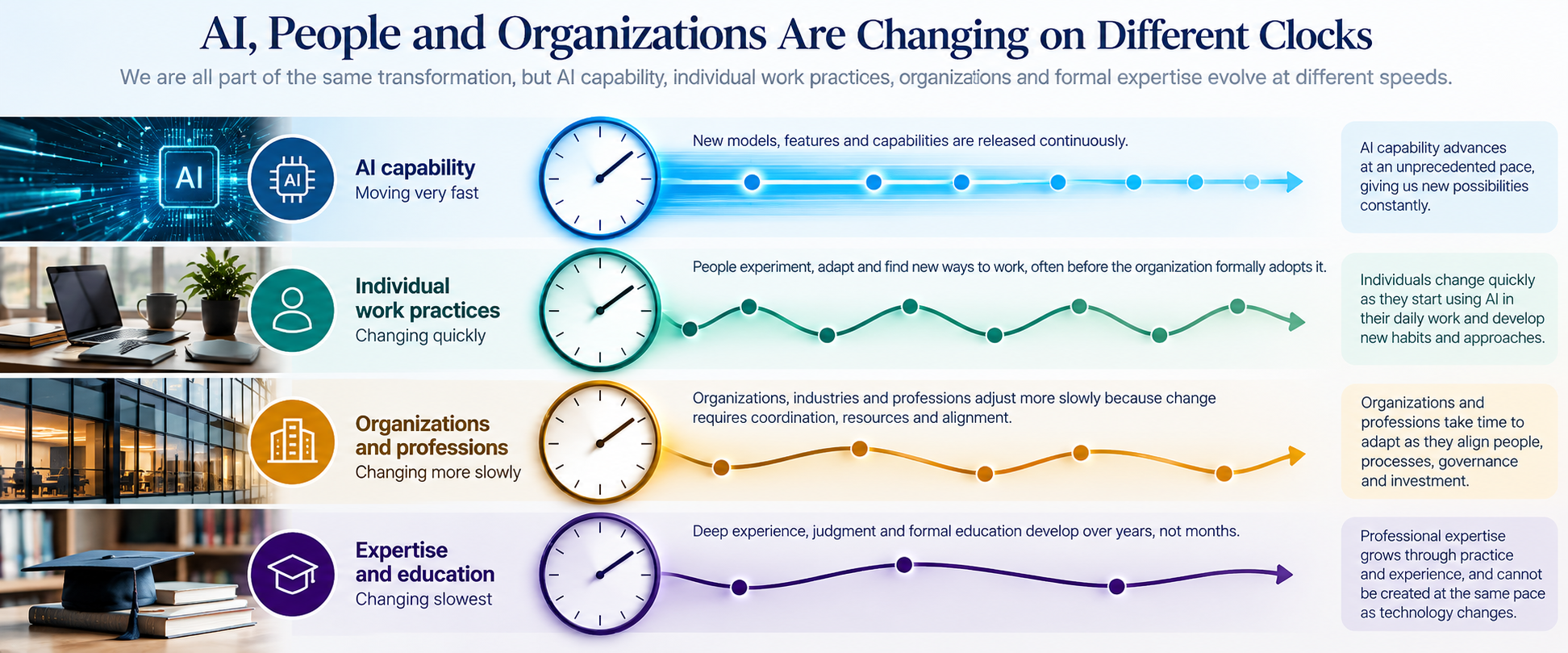
The third difference is the one I find hardest. Expertise has always been built from the bottom of the ladder. People became experts by doing the routine work, then the analysis, until judgment came. AI now does the routine work and much of the analysis, so the rungs people climbed to become experts are the rungs the machine occupies. What it means to be an expert is being reshaped, and so is the way anyone becomes one. How a person builds judgment when the apprenticeship beneath it is gone, how a company learns from changes it did not initiate, and how far the division of work should move while it is still moving are the questions this transformation leaves open, and no earlier one had to answer them.