The gap between rankings and AI search visibility matters because buyer behavior has already moved. Prospects now build shortlists inside AI answers before they visit a single website. The businesses named in those answers win consideration first. The rest get filtered out without ever knowing a deal existed.
This article explains what changed, what the research shows, why AI answers pass over businesses that rank well, and what to fix first.
- AI answer engines are now the most meaningful research source for B2B buyers, ahead of vendor websites, product experts, and sales representatives.
- Google ranks pages, while AI answers recommend brands. About 12 percent of sources cited by AI chatbots rank in Google’s top 10.
- Rankings still matter. AI visibility adds new requirements: third-party trust signals, direct answers on your pages, and freshness.
- AI visibility varies service by service, not brand by brand. Measure it per topic and per platform before deciding what to fix.
- Visitors who arrive from AI answers convert at about 4.4 times the value of traditional organic visitors, making the gap a revenue problem.
How People Now Search for a Business Like Yours
The visibility gap starts with behavior, not technology. Three shifts define how buyers now look for providers.
Buyers Start Their Research Inside AI Answers
Forrester’s 2026 Buyers’ Journey Survey of nearly 18,000 business buyers found that 94 percent used AI during their most recent purchase. That is up from 89 percent the year before. Buyers ranked AI tools as their most meaningful source of purchase information, ahead of vendor websites, product experts, and sales conversations. More than half compare vendors inside AI tools, and 47 percent build their internal business case before contacting anyone (Forrester, January 2026).
The pattern holds beyond the enterprise. G2’s 2026 buyer research found 51 percent of B2B software buyers now begin their purchase process in an AI chatbot rather than a search engine. More telling: 69 percent chose a different vendor than they originally planned because of AI guidance. One in three bought from a vendor they had never heard of before the AI named it.
Read that statistic from the other side: two in three shortlists changed inside an AI answer, and the displaced vendors never saw it happen.
Follow one deal through those numbers. The COO of an 80-person software company needs an outsourced accounting firm. She starts in ChatGPT: which firms work with a company her size, and what should she look for? The answer names four firms and criteria she had not considered.
Her shortlist now exists, and no website has been visited. Over the next week she checks LinkedIn to see what peers say about two of the firms and reads a Reddit thread comparing them. She returns to the AI to compare the two finalists for software companies, then has it draft the one-page case her CFO will see.
Only then does she visit two websites and fill out one contact form. The firm that ranks first on Google for outsourced accounting services, but went unnamed in both AI conversations, never knew this deal existed.
Google Did Not Disappear. The Results Page Changed
AI adoption has not replaced search. Orbit Media’s March 2026 survey found more than half of respondents now start some searches in an AI app, while Google usage has not declined. A separate 2026 study found 37 percent of consumers now start searches with AI rather than a search engine. People added a research layer; they did not swap one for another.
The bigger change happened inside Google itself. When an AI Overview appears above the results, the top-ranked page loses up to 58 percent of its expected clicks, according to Ahrefs. Pew Research Center found users clicked a traditional result on 8 percent of searches with an AI summary, against 15 percent without one. Even people who never open ChatGPT now read answers instead of results pages.
The same shift reads differently in a consumer purchase, where social platforms enter early. A homeowner planning a kitchen remodel starts on TikTok, Instagram, and Pinterest, collecting ideas and watching renovation videos. Weeks of passive research shape the project before any provider search begins.
When it is time to hire, the homeowner reads a Nextdoor or Reddit thread on local contractors. Then comes Google’s AI Mode with three questions: which remodelers handle this kind of project, what it should cost, and what to check before signing. The AI answer draws on review profiles, community threads, and contractor websites.
The homeowner cross-checks the two named finalists on Google Maps reviews and visits one website to request a quote. The contractor with the strongest portfolio site in the market never appeared. Its record outside its own website was too thin for the AI to trust.
What This Means for a Services Firm
Hiring a professional services firm is a trust decision with a long research phase. That research now produces a shortlist before first contact. Forrester found buyers validate what AI tells them with peers and industry analysts, not with vendors. Your first impression is now formed in an answer you never see.
Notice what both journeys share. Social platforms, communities, and reviews did not act as separate marketing channels. They were the source material the AI answers were assembled from. A business can sit outside that record, rank well, and never enter the conversation where the decision forms.
One more number completes the stakes. Visitors who arrive from AI answers convert at about 4.4 times the value of traditional organic visitors, per Semrush’s traffic research. The behavior explains the premium: by the time an AI-referred visitor lands on your site, the comparison already happened, and you won it. Losing AI visibility does not only shrink traffic; it removes your firm from the highest-intent path buyers now take.
The direction of travel extends this one step further. The next phase is already visible in early form: agentic search, where an AI assistant runs the research, comparison, and shortlist on a person’s behalf. In some cases it completes the transaction. Harvard Business Review reported in March 2026 that brand data inside these systems is often incomplete or wrong. An absent brand has no way to correct the record mid-decision.
When the searcher is software, every signal in this article stops being a marketing asset and becomes the storefront itself. Nothing about that changes the work ahead; it raises the price of skipping it.
Honesty requires one caveat. Roughly a third of consumers say they are unlikely to ever trust AI chat tools. AI answers are an added front door, not the only one. Getting found wherever people search is the standard now, across Google, AI assistants, and the platforms in between. Our Search Everywhere Optimization guide maps that wider landscape. This article stays on the specific problem inside it: why strong rankings fail to carry over into AI answers.
Ranking and Being Recommended Are Two Different Systems
Google evaluates pages against a query and orders them by relevance and authority. An AI assistant does something different. It gathers sources, weighs which brands it can trust and extract, and assembles one answer naming a handful of providers. Those are different competitions with different scoring.
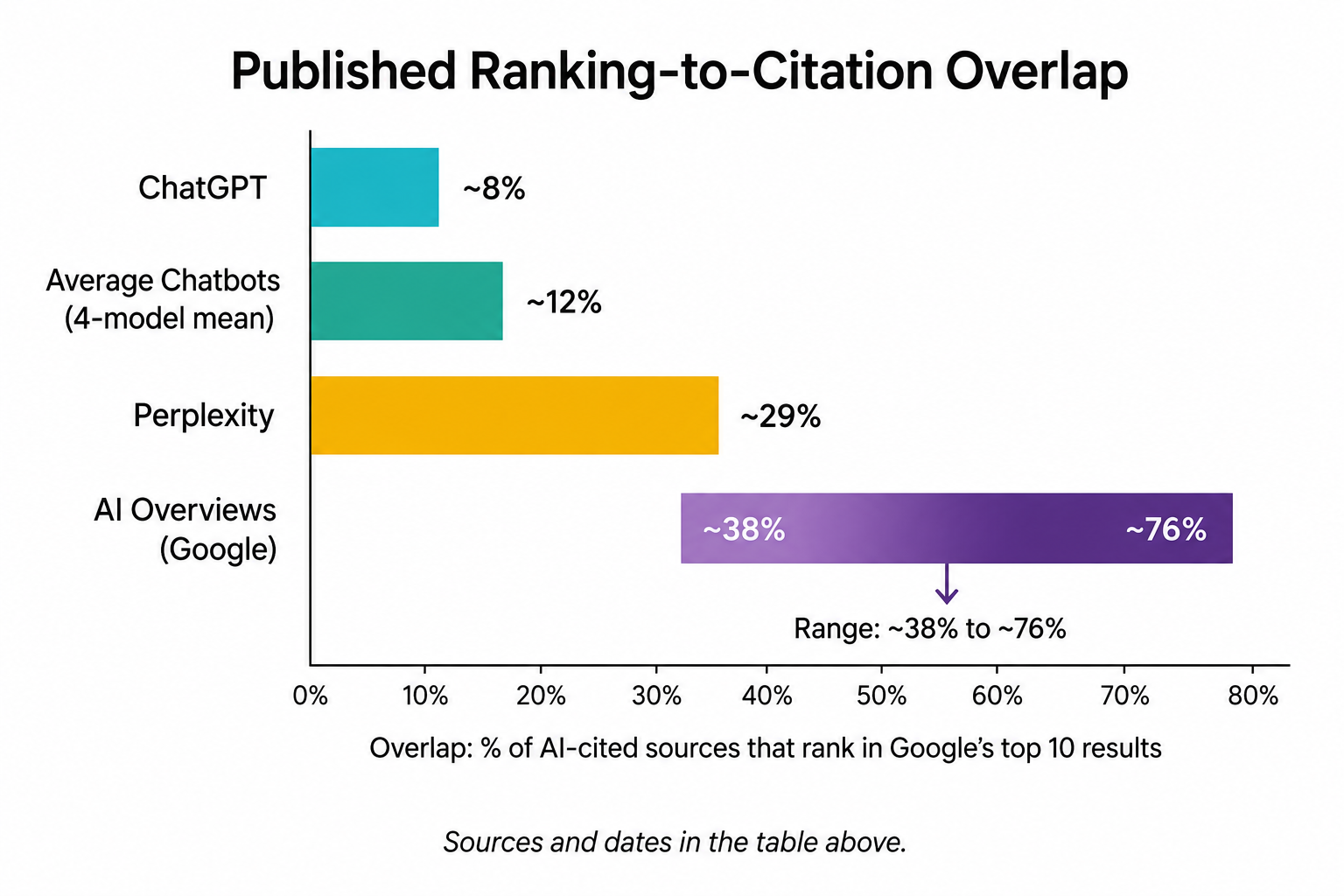
The data shows how different. Ahrefs analyzed 15,000 prompts across ChatGPT, Gemini, and Copilot. On average, only 12 percent of the cited links appeared in Google’s top 10 for the same prompt. Perplexity was the most search-aligned engine at about 29 percent. In other words, the chatbots build most of their answers from sources Google’s first page does not show.
“Google ranks pages. AI answers recommend brands.”
One distinction keeps the rest of this article precise. A mention means the AI names your business in its answer. A citation means the AI used your website as a source. A brand can be mentioned without being cited, and cited without being mentioned. The two move on different signals, and both matter.
None of this makes your SEO investment wasted. It makes it incomplete. Rankings remain one input into AI visibility, and the foundations behind them still carry weight, as we covered in how generative AI is reshaping SEO. What has changed is that rankings stopped being the whole scoreboard.
What the Data Shows About the Ranking-to-AI Gap
Published research on this gap appears contradictory, with overlap figures ranging from 12 percent to more than 50 percent. The disagreement is not noise. It is the finding, and it rewards a careful read.
Google’s AI Overviews Track Rankings, but Less Each Year
AI Overviews sit on the search results page, so they lean on rankings more than any chatbot. In mid 2025, Ahrefs found 76 percent of AI Overview citations came from pages ranking in Google’s top 10. By early 2026, across 863,000 keywords, that figure had fallen to 38 percent. Ahrefs notes part of the drop reflects improved measurement, a caveat most coverage skips.
BrightEdge, measuring differently, tracked overlap rising from 32.3 percent to 54.5 percent between May 2024 and September 2025. Other analyses later showed it falling again. The methods disagree on the level. They agree on the structure: even at its peak, roughly half of AI Overview citations came from pages that were not ranking at the top. In plain terms, AI Overviews now find most of their sources beyond the top of the rankings, and the share keeps drifting that way.
Chatbots Barely Track Rankings at All
ChatGPT cites Google’s top 10 results about 8 percent of the time. Seer Interactive approached the question from the brand side. It found page-one Google rankings correlate at about 0.65 with brand mentions in ChatGPT answers. In practical terms, ranking well makes a mention more likely and guarantees nothing. The same study found backlinks, the currency of traditional SEO, showed weak to no correlation with AI mentions. Correlation is not causation, and Seer says so plainly. The direction is still hard to ignore.
Why the Published Numbers Disagree, and What They Agree On
Four things drive the spread in the published figures. Studies measure different engines, and AI Overviews behave differently from chatbots. Some count brand mentions while others count URL citations. Methodologies differ and keep changing. And the engines themselves change under the researchers, as when Gemini 3 became the default model behind AI Overviews in January 2026.
| Study | What it measured | Finding |
|---|---|---|
| Ahrefs, Aug 2025, 15,000 prompts | Chatbot citations appearing in Google’s top 10 | About 12 percent on average; Perplexity highest at 29 percent |
| Ahrefs, 2025 to 2026 | AI Overview citations from top-10 pages | 76 percent falling to 38 percent, with a measurement caveat |
| BrightEdge, May 2024 to Sept 2025 | AI Overview citation overlap with top rankings | 32.3 percent rising to 54.5 percent by its method |
| Seer Interactive, 2025 | Correlation of page-one rankings with ChatGPT brand mentions | About 0.65; backlinks showed little to none |
What every study agrees on: the overlap is partial everywhere, smallest in the chatbots, and rankings explain less of AI visibility over time.
We watch this gap from both sides in our own client work. One client, a multi-office wealth management firm, has led its local and organic rankings for years. Top-tier AI answers still do not name it when prospects ask for advisor recommendations in its markets. That is no accident: in trust-sensitive categories like finance, AI answers lean hardest on third-party records, which raises the bar for any single firm. Another client, a specialty pet care business in a major metro market, is the most referenced provider in its category in AI answers. It holds 97.7 percent of tracked brand mentions in its competitive set, ahead of two national brands. When AI names providers in the category, this client appears first or second on average. Rankings alone would predict neither outcome.
Why AI Answers Pass Over Businesses That Rank Well
Three mechanisms explain most of the gap, and each one is fixable.
AI Leans on What Others Say About You
Yext analyzed 6.8 million AI citations and found 86 percent came from brand-managed sources, meaning first-party sites plus business listings, review platforms, and directories. Semrush’s 2026 AI Visibility Index analyzed 126 million prompts. It found brands with active third-party trust signals were cited 75 times more often than brands without them. Both are vendor studies, worth reading with that in mind, and both point the same direction as the independent data.
A ranking rewards what your website says. An AI answer weighs what reviews, directories, industry publications, and communities say about you. For a firm that built visibility on its own domain alone, that record is often thin, and AI reads the silence.
AI Lifts Direct Answers, Not Optimized Pages
AI assistants extract passages, and they favor passages built to be extracted. A Search Engine Land analysis of pages cited by ChatGPT found 72.4 percent placed a short, direct answer immediately after a question-based heading. The same analysis found 44 percent of citations pointed to the first third of the page. Research from Princeton and Georgia Tech found that statistics, quotations, and source citations lifted a page’s visibility in AI answers by 30 to 40 percent.
Most service pages fail this test without being bad pages. They open with positioning language, describe process, and never state a complete answer a machine could quote. The page ranks because it is relevant and authoritative. It goes uncited because nothing in it stands alone. Well-structured, substantive content that builds authority serves both audiences at once, human readers and the machines answering them.
AI Favors Fresh and Specific Over Established and Broad
Ahrefs found AI assistants cite content that is about 26 percent fresher than what ranks in organic results for the same queries. Its analysis of ChatGPT’s most-cited pages found 67 percent were original research, first-hand data, or academic sources. Age and breadth, two things established firms accumulate, earn little here. A service page untouched since 2022 loses the citation to a thinner but current page with one specific, quotable fact.
The Popular Fixes That Do Not Work
The gap has produced a market for shortcuts, and the three most popular do not hold up.
The first is llms.txt, a proposed file that supposedly tells AI systems what to read. Google’s own AI optimization guidance states that Google Search does not use it, and no major AI platform has confirmed consuming it. The second is schema markup as a citation guarantee. Schema helps machines parse your pages and remains worth doing, but Google’s guidance is direct: structured data does not buy inclusion in AI answers. The third is the Bing shortcut, the claim that ChatGPT runs on Bing so businesses should optimize there. That advice describes an old architecture; current research shows ChatGPT’s citations align no better with Bing’s top results than with Google’s.
The pattern behind all three is the same. Quick fixes sell because the real work, earning third-party trust and restructuring content, is slower. Google’s May 2026 guidance says optimizing for AI search is still SEO at its foundation. The foundation is necessary. The signals built on top of it are what the shortcuts try, and fail, to fake.
What a Quick AI Check Can and Cannot Tell You
You can get a first signal on your AI search visibility in about 20 minutes. Treat it as a signal, not a diagnosis.
- Write down five questions a prospect would ask before hiring a firm like yours. Phrase them the way a person speaks, not the way a keyword reads.
- Ask each question in ChatGPT, Perplexity, and Google’s AI Mode.
- Record which businesses get named, which websites get cited, and where you appear, if at all.
- Repeat the exercise for your strongest service and your weakest.

Then apply the limits. AI answers vary between sessions, users, locations, and phrasings, so a single absence proves little, and a single appearance proves less. What counts is the pattern across many prompts over time.
Real measurement looks different. It uses a fixed set of prompts tracked month over month, per service topic and per platform. It records mentions, citations, average position, and share of voice against named competitors. Our client tracking shows why the narrow test misleads. The same business that leads its market in AI answers overall holds above 50 percent visibility on its strongest service topic. On its weakest, it holds under 1 percent. A spot check aimed at the wrong service would call a market leader invisible.
The quick check still earns its 20 minutes. If you rank well and the AI answers name your competitors across several questions and platforms, you have found the gap this article describes. The next section is your priority order.
What to Fix First: The Adaptive SEO Priority Order
Closing the gap is sequenced work, not a checklist to sprint through, and the sequence below fits most B2B and professional services firms. This is what our adaptive SEO services mean in practice: keep the search foundation, then build the signals AI answers weigh. The approach draws on the WSI AdaptiveSEO framework our global network developed for this shift.

Put Direct Answers on the Pages That Earn Money
Start with the service pages that produce revenue. Give each one question-based headings that match how prospects ask, and place a complete two-to-three sentence answer immediately under each heading. Add the specific facts a machine can quote: numbers, timelines, and named outcomes. This is the highest-leverage fix because it converts pages that already rank into pages that can be extracted.
Build the Third-Party Record AI Reads
Make the evidence about your firm match the claims on your website. That means current reviews on the platforms your buyers check and accurate, consistent directory listings. Add earned mentions in the industry publications and communities your prospects trust. For B2B firms, this is the slowest fix and the strongest one, because it is the signal weighted most heavily and copied least easily.
Make Your Business Unmistakably Identifiable
AI systems recommend entities they can resolve with confidence. Use one consistent business name, description, and service list everywhere you appear. Maintain a substantive About page and author pages with real credentials. Ambiguity that a human reader forgives, a machine treats as risk, and it recommends someone else.
Keep It Fresh and Start Measuring
Set an update cadence for your money pages and refresh the facts, not just the dates. Then measure AI visibility the way you measure rankings: mentions, citations, position, and share of voice, tracked per topic and per platform each month. What you measure decides what you notice, and firms still watching only rankings will not see this gap until it costs them.
Find Out Where You Stand
The quick check tells you whether a gap might exist. A measured analysis tells you whether it is real, which services it affects, and what closing it will take.
Mikesell Digital is an AI-powered growth and digital marketing advisory firm. We run this analysis for B2B and professional services businesses. It covers your rankings, your AI visibility per service and per platform, and your competitors’ positions in both systems. The result is a prioritized plan built from the evidence. Get a free competitive analysis to see where you stand. And if your questions reach past visibility into how your firm should adopt AI in its marketing, our AI consulting services start there.
AI Search Visibility Questions Business Owners Ask
Is having a good website enough to show up in AI answers?
No. A well-built website is the foundation, and it is not sufficient on its own. AI assistants weigh what other sources publish about a business, including reviews, directories, industry coverage, and community discussion, alongside the business’s own pages. A firm with an excellent site and a thin third-party record will usually lose AI recommendations to a competitor with visible external proof.
Does my business need to be well known to appear in AI answers?
No. AI answers reward documented trust on specific topics, not general fame. A specialty firm with direct-answer content, strong reviews, and consistent listings can appear more often than national brands for the services it does best. In most service categories, few businesses compete deliberately for AI visibility, so the advantage belongs to whoever builds the record first.
How long does it take to improve AI search visibility?
Plan in months, not days. Content and structural fixes can show early movement within weeks on chat assistants, while third-party trust signals build over months. Timelines vary by platform, topic competition, and how often each AI system refreshes its sources. Track monthly and judge by trend, not by any single answer.
Does appearing in AI Overviews improve traditional SEO results?
The two reinforce each other. Seer Interactive found brands cited inside an AI Overview earned about 35 percent higher organic clickthrough than uncited brands on the same results page. AI visibility work also strengthens classic ranking signals, since direct answers, freshness, and third-party authority serve both systems.
What is the difference between SEO, GEO, and AEO?
SEO (search engine optimization) is the discipline of earning visibility in search engines. GEO (generative engine optimization) and AEO (answer engine optimization) are newer terms for earning mentions and citations in AI-generated answers. The labels overlap and the industry has not settled on one. The work behind them is what this article describes: sound search foundations plus the trust, structure, and freshness signals AI systems weigh.
Should we stop investing in SEO and move the budget to AI visibility?
No. Rankings still feed AI Overviews, and the foundations behind rankings support AI visibility everywhere. The evidence favors integration. Semrush’s 2026 research found 81 percent of organizations managing SEO and AI visibility as one workflow reported more traffic and leads from AI platforms. Among those managing the two separately, 36 percent did. Add the new work; do not abandon the old.