A strong prospect can be deep into a buying decision before your CRM knows they exist.
They may have found one of your articles through Google, seen a discussion on LinkedIn, or read a Reddit thread about the problem. They may have asked an AI tool to compare approaches, checked reviews, listened to a podcast, watched a webinar, or asked a trusted colleague for a recommendation. Then they may have visited your service pages and shared what they found with someone else on the buying team. By the time they fill out a form, they may already know whether your firm belongs on the shortlist.
That invisible stretch is where many nurture programs are weakest. Buyers now move among search, AI, social platforms, peer conversations, third-party sources, and company websites. Much of that activity happens before they identify themselves to a provider.
The 2025 B2B Buyer Experience Report from 6sense found that buyers made first contact about 61 percent of the way through the buying journey. It also found that 95 percent of winning vendors were already on the buyer’s Day One shortlist. Buyers may be contacting sellers earlier than they did a year ago. Still, the firms that win are usually known well before a sales conversation begins.
Gartner’s March 2026 buyer research points in the same direction. Sixty-seven percent of B2B buyers said they prefer a rep-free experience. Forty-five percent reported using AI during a recent purchase. AI is becoming an important research tool, but it is one part of a broader discovery process that buyers control themselves.
For a B2B or professional services firm, this changes the job of lead nurturing. Sending more emails after someone downloads a guide is too narrow a definition. Good nurture helps the right buyers make progress while they research independently. It keeps answering better questions as the decision becomes more serious.
Key Takeaways
- Buyers often form shortlists and preferences before they contact a provider. Meaningful nurturing therefore begins before the prospect becomes visible in the CRM.
- Useful nurture changes as the buyer’s questions change.
- Useful personalization reflects what the buyer has already learned instead of inserting personal details into generic messaging.
- AI can surface patterns across behavior, timing, topics, and accounts. Those signals can focus human attention, but they do not prove buying intent.
- The best test is not how many touches the system generated. It is whether the eventual conversation is better informed, better timed, and with a prospect the firm actually wants.
The Buyer You Cannot See
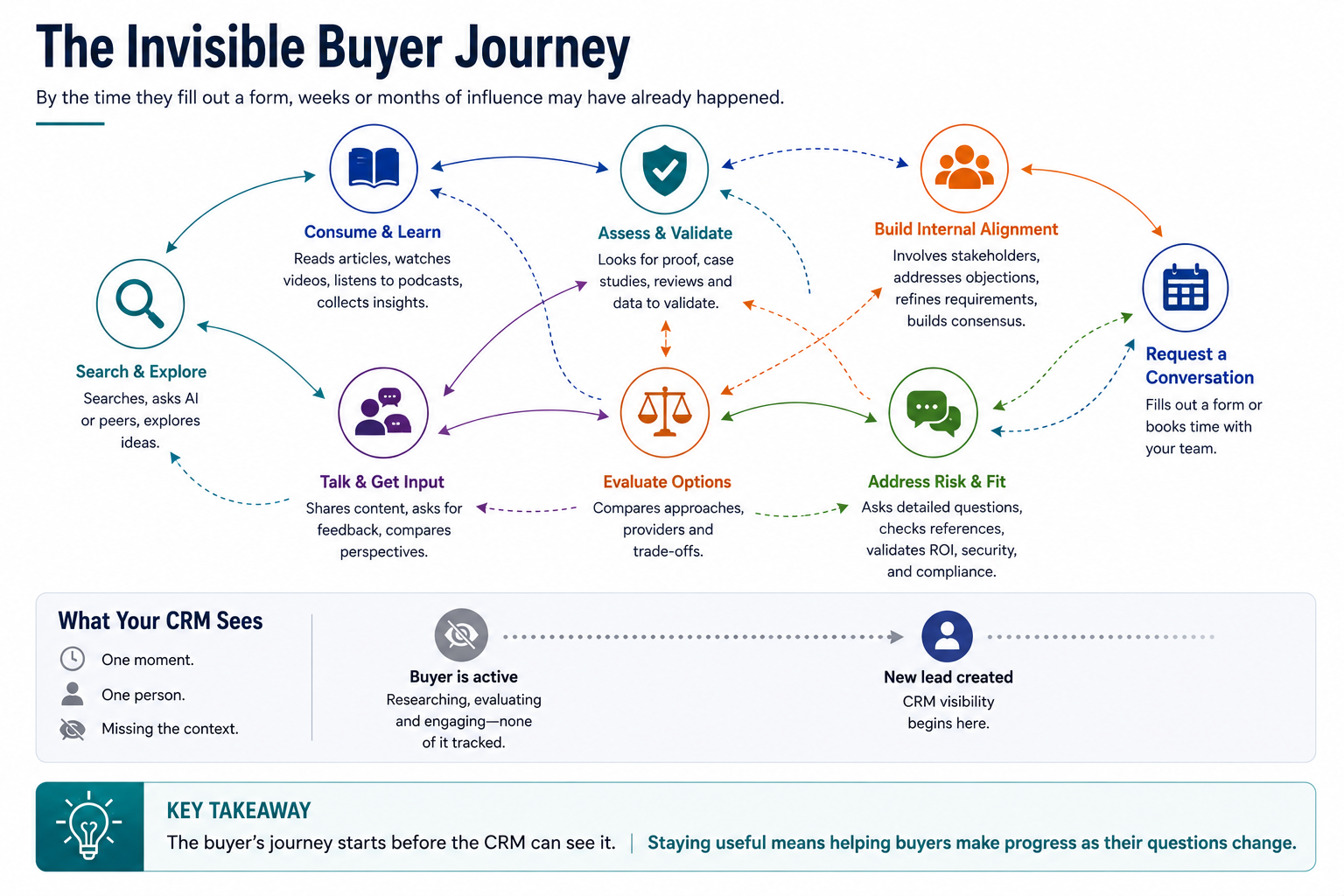
Consider how a professional services purchase can unfold from the buyer’s side.
A managing partner realizes her firm has a problem. She is not yet sure whether it requires outside help. She searches the issue, reads an article from a consulting firm, and leaves without identifying herself.
A few days later, a LinkedIn post raises a question she had not considered. She reads the comments, checks a discussion on Reddit, and asks an AI assistant to compare the approaches she is seeing. One answer reinforces an idea from the article, so she returns to the consulting firm’s website and opens a more detailed guide.
Still no form submission.
She sends that guide to the firm’s operations director and asks a trusted peer whether they have dealt with something similar. The director visits from a different device and reads a case study. A few weeks later, the managing partner returns to review the service page and implementation information.
Only then does she request a conversation.
If you look only at the CRM, the opportunity appears to have started on the day she completed the form. In reality, the decision had been developing for weeks, and several people had already interacted with the firm’s thinking.
Search and AI may help the buyer discover or understand the issue. LinkedIn, Reddit, reviews, peers, industry content, and other third-party sources can shape trust and validation. The firm’s own articles, case studies, service pages, and reputation add another layer. Much of that influence develops before sales has a name to follow up with.
When we evaluate lead generation, we work backward from strong opportunities. We ask what the buyer had already seen, learned, compared, or shared before the CRM captured the lead. The evidence is often imperfect. Ignoring it still leaves the firm with an incomplete picture of what created confidence.
Mikesell Digital’s approach to Intelligent Lead Generation is built around this broader journey:
- attracting the right prospects,
- recognizing fit and readiness,
- staying useful while people research, and
- giving the eventual sales conversation more context than a cold form submission can provide.
Good Nurture Follows the Decision, Not the Marketing Calendar
Many nurture programs are beautifully organized around platform logic. The buyer’s decision process is usually much messier.
- A prospect downloads a guide,
- receives an immediate welcome email,
- gets introduced to the service a few days later,
- receives a case study after that, and
- then receives meeting requests because the automation has reached the conversion point in its sequence.
Operationally, everything worked.
The sequence knows when the prospect entered the database. It may know very little about what that prospect is trying to decide now.
Match the Message to the Decision
If someone has spent weeks comparing approaches, another introductory article does not help. If the concern has moved to implementation, more awareness content takes the buyer backward. A buyer building internal support needs credible proof they can share. Repeated meeting requests can create pressure at exactly the wrong moment.
Recent Gartner research reinforces why that mismatch matters. Buyers increasingly prefer self-directed research for general information. Earlier Gartner research found that 73 percent actively avoid suppliers whose outreach feels irrelevant to their needs. Every additional interaction has to earn attention by helping with the decision in front of the buyer.
WSI’s July 2026 guidance reaches a similar conclusion for prospects who arrive already informed. These buyers need proof, context, implementation clarity, and help reducing uncertainty. Another round of introductory education rarely moves the decision forward.
The same principle applies before the inquiry.
A useful nurture system follows the direction of the decision. The automation calendar should support that work, not drive it.
Here is a simple test. Remove the company name from the next message. Would it still feel like the logical next step in the buyer’s decision? If not, the sequence may be following its own schedule.
The Mikesell Buyer-Progress Nurture Model
The Mikesell Buyer-Progress Nurture Model organizes nurture around the questions buyers are working through. Those questions tell us what information may have value now.
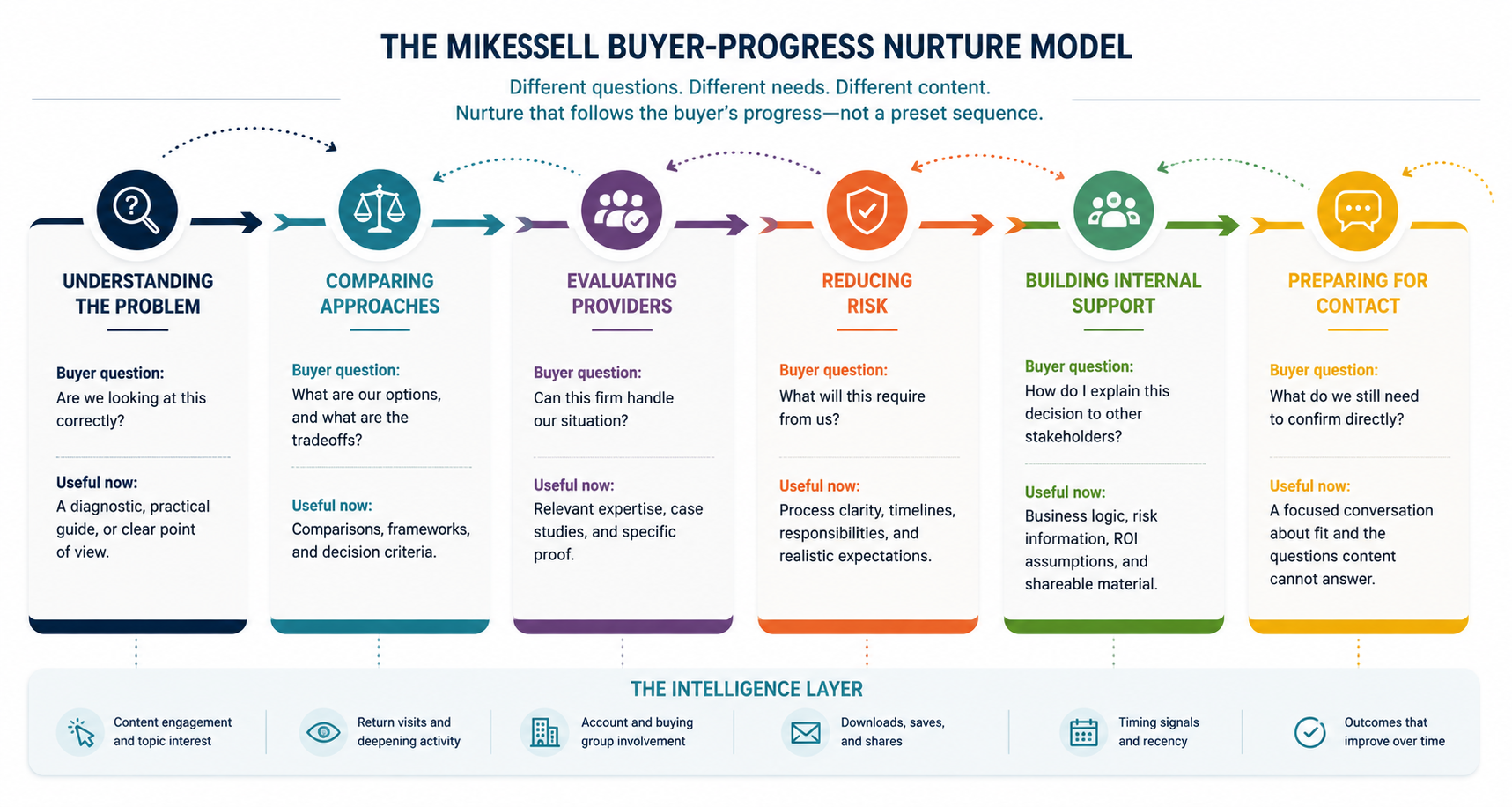
Real buyers rarely move cleanly from the first state to the sixth. They stop, return, reconsider, bring in new stakeholders, lose budget, regain urgency, and reopen questions that seemed settled.
The model helps the marketing team choose what may be useful next. It leaves room for the stops, reversals, and detours that happen in real buying decisions. Its purpose is to sharpen judgment under uncertainty.
The Next Question Matters More Than the Next Email

Imagine that a prospect has spent the last month reading about AI adoption.
They understand why AI matters and have explored several possible use cases. Now they are asking a harder question: is the organization ready to change how work gets done?
Then the nurture campaign sends them another article titled Five Reasons Your Business Should Start Using AI.
The topic matches their interest perfectly. Yet the content misses the decision they are trying to make.
At this stage, the questions are more likely to be practical:
- Where should we start
- What information can employees safely put into these tools
- How much training will people need
- Which process should we test first
- How will we know whether the implementation is producing enough value to justify expanding it?
Those questions should determine what the prospect encounters next.
Personalization Should Continue the Conversation
Personalization needs a higher standard than most marketing software sets.
A first name, company, role, or industry can make a message feel more specific. Those details do not show that the firm understands the buyer’s decision. Suppose the buyer has already explored AI adoption, implementation risk, employee training, and governance. The next interaction should build from that history instead of sending another beginner’s guide.
Continuity is what makes personalization useful. Good personalization recognizes what the buyer already understands and moves the conversation forward from there.
A good system should remember what the buyer has already consumed. It should also notice which questions appear to be gaining importance. That context makes better content recommendations possible and prevents the nurture program from repeatedly restarting the conversation.
That is one of the places where our AI consulting work intersects with lead generation:
AI is useful here because people cannot reasonably interpret hundreds or thousands of behavioral signals by hand. It can surface patterns worth reviewing. Those patterns only matter when the business has clear fit criteria, worthwhile content, and data good enough to trust.
Your Buyer May Not Be One Person
The person who discovers your firm may never be the person who approves the decision. That is one reason B2B nurturing gets complicated quickly.
The 2025 Edelman and LinkedIn B2B Thought Leadership Impact Report calls these less-visible decision-makers hidden buyers. They may sit in finance, legal, compliance, procurement, operations, or another function. They may never become the obvious sales contact. Yet they can still determine whether a purchase moves forward. The report found that more than 40 percent of B2B deals stall when buying groups cannot reach internal agreement. It also found that hidden buyers use thought leadership to evaluate companies and ideas.

Content Has to Survive Being Forwarded
For a professional services firm, this creates a demanding standard: your nurturing content has to survive being forwarded.
The content should carry its own context. A finance leader, partner, general counsel, or operations executive may never see the original exchange. They should still understand the problem, the tradeoffs, and why the recommendation deserves attention.
Different stakeholders will test the idea in different ways. Operations may focus on implementation and disruption. Finance may care about cost and payback. Legal may focus on exposure. Senior leadership may ask whether the expected benefit justifies the organizational effort.
Your original contact should not have to rewrite your argument for all of them.
A strong article, case study, guide, or executive summary should stand on its own. A new reader should understand the issue, the tradeoffs, the evidence, and your firm’s point of view. Content that only makes sense inside the campaign that delivered it is too dependent on the campaign.
This is also why content that builds authority plays such an important role in nurturing. Good content can influence internal conversations that your marketing platform never records and your salesperson never attends.
What AI Can See That Your Team Cannot
Buyers move across articles, service pages, newsletters, events, AI search, and conversations with colleagues. Several people from the same account may be involved. That behavior quickly becomes difficult to interpret by hand.
Suppose one prospect reads a general article and disappears. Another reads the same article, returns several days later, opens an implementation guide, and visits a service page. Then a second visitor from the same organization reads a relevant case study.
Those two prospects may look identical if the business is counting only initial conversions.
They do not look identical when the full pattern is visible.
AI can detect changes in frequency, depth, topic, and account-level activity. It can summarize what someone explored before a conversation and suggest content for the next question. It can also surface accounts that deserve a closer human look.
What it cannot do is tell you with certainty why the behavior occurred.
Three visits to a pricing page may signal buying interest. They may also come from a competitor doing research. Five article views could mean a serious project or an employee preparing an internal presentation. A prospect who goes quiet may have lost interest. Their budget may also be six months away.
Behavior Is Evidence, Not Certainty
“Behavior gives you evidence. People still have to interpret it.”
This is where scoring models often go wrong. They are useful for prioritization, but weak as prediction engines.
Behavior gives you evidence. People still have to interpret it.
Gartner’s May 2026 buyer study shows the same tension from the buyer’s side. Forty-five percent of respondents had used GenAI during a recent purchase. Yet 69 percent preferred to validate AI-generated insights with a sales representative. Buyers value the efficiency of digital and AI-assisted research. They still turn to people for context, reassurance, and help with decisions specific to their situation.
A well-designed nurture system should follow the same principle. Use AI where scale and pattern recognition create an advantage. Bring in human judgment when context changes the answer. AI can tell you where to look. It cannot tell you, with certainty, what a buyer means.
Silence Is Not Automatically a Signal to Send More
Marketing automation has a natural tendency to treat inactivity as something the system should correct.
When someone stops opening emails, marketers often react quickly. They change the subject line, shorten the interval, switch the offer, or add another touch. The assumption is that one more message might bring the buyer back.
Sometimes it will.
Sometimes the buyer has simply stopped needing you for the moment.
Several explanations are possible. The project may have lost budget. Priorities may have changed, or another stakeholder may now own the decision. The buyer may also have learned enough and plan to return later. Without more evidence, the system cannot know which explanation is true.
A good nurture strategy needs rules for slowing down as well as rules for escalating. Restraint is part of the strategy.
Another generic message does not resolve uncertainty simply because the platform can send it. When there is nothing useful to add, waiting can protect more trust than another attempt to manufacture engagement.
Start With the Last Ten Clients You Would Like Ten More Of
When I evaluate a nurture program, I start with the clients the firm would genuinely like to replicate. The automation platform can wait.
Take the last ten strong clients and work backward through whatever evidence is available. This quickly moves the discussion away from generic nurture tactics and toward the firm’s real buying patterns.
- How did they first discover the firm?
- Which content did they consume before reaching out?
- Did they come back several times?
- What questions appeared once the conversation became serious?
- Was another person from the company involved?
- Which concerns nearly stopped the engagement?
- How long had they known about the firm before anyone realized there was an opportunity?
Look for Patterns and Gaps
The data will rarely be perfect, especially in organizations that started measuring at the form submission. That is still enough to learn from. Incomplete evidence can reveal patterns that are more useful than another generic automation template.
The strongest clients may have read implementation content repeatedly before they contacted the firm. They may have received the newsletter for months before visiting a service page. Referrals may behave very differently from prospects who arrive through paid campaigns. Case studies may matter much later than the marketing team assumed.
Those observations should influence the content and nurturing system.
Then look for what is missing. Nurture problems are often content problems in disguise.
If prospects repeatedly reach an implementation question and the website offers nothing useful, another email sequence will not help. The same is true when buyers need proof but every case study is generic. Fix the content gap before adding more automation.
This is where lead generation and conversion start to work as a connected system. The firm learns which prospects fit and what information helps them progress. It sees where useful context disappears and which signals deserve human attention. Automation can then carry those lessons into the work at scale.
Measure Whether Better Buyers Are Moving
A nurture program can have excellent open rates and little commercial value. That happens when the most engaged people are not the clients the firm wants to win.
For nurturing specifically, I would concentrate on three questions before adding a larger dashboard.
First, are good-fit prospects moving toward meaningful conversations? Or is the program simply creating more activity from people who were unlikely to become suitable clients?
Second, which content paths repeatedly appear before strong conversations? Do not try to credit one blog post for the entire engagement. Look for the information that repeatedly helps buyers move from general research into serious evaluation.
Third, examine the first conversation. A well-nurtured prospect should understand more about the firm’s thinking. The firm should also have useful context about the prospect. Both sides can spend less time repeating introductions and more time discussing the actual situation, risks, priorities, and fit.
The broader Intelligent Lead Generation system should still measure fit rate, progression, cost per client won, journey length, referrals, and repeat business. Here, the narrower question is whether the period before the conversation makes that conversation better.
Keep the measurement standard simple. Are better-fit buyers moving with less confusion and more useful context? A busy-looking nurture program tells you very little on its own.
Where AI Belongs in the Nurture System
AI does not need to headline every part of this process.
Use AI where it improves the work without lowering the quality of the thinking.
Use it to:
- connect behavior across channels
- recognize patterns that a person would not reasonably track at scale
- identify accounts worth reviewing
- recommend relevant content
- summarize a prospect’s journey before a meeting
- learn from what happened after opportunities were won, lost, or delayed.
AI should never become an excuse to produce more communication nobody needed.
A weak nurture strategy does not become intelligent because the automation is sophisticated. Wrong fit criteria help AI prioritize the wrong prospects faster. Shallow content can be distributed more precisely. An irritating sequence can become impressively personalized and remain just as irritating.
Business logic comes first. Otherwise, AI only makes a weak nurture system faster and more efficient at being weak.
That is the same principle we use throughout our work in AI adoption and consulting: determine where the technology genuinely belongs, establish what better performance looks like, and then use the tool to strengthen a process that has already been thought through.
See Where Good Prospects Lose Momentum
Good prospects sometimes find your firm and disappear before a meaningful conversation. The problem may sit in the part of the journey your CRM cannot see clearly.
Several things may be happening. The information may no longer match the buyer’s question. The proof they need may be hard to find. A meaningful change in behavior may go unnoticed. Or the automation may keep running after a human conversation would be more useful.
Mikesell Digital helps B2B and professional services businesses look across that full path, from getting found wherever people search through content, nurturing, fit signals, AI-assisted analysis, and the point where a prospect is ready for meaningful human context.
The goal is a more useful nurture system, not a longer sequence or a noisier marketing machine.
Help the right buyers reach a better-informed decision. Give your team a better first conversation when those buyers are ready.
Book a conversation to see where good prospects are moving forward, where useful context disappears, and what a more intelligent nurturing system should do differently.
Frequently Asked Questions About B2B Lead Nurturing
What is B2B lead nurturing?
B2B lead nurturing helps prospective business buyers make progress toward an informed decision. It uses useful content, relevant follow-up, behavioral context, and timely human support. Nurturing can begin before a prospect identifies themselves and continue until a direct conversation becomes useful. That makes it broader than a conventional email sequence.
Is lead nurturing just email marketing?
No. Email can support lead nurturing, but it is only one part of the buyer’s journey. Buyers also move through websites, search, AI assistants, social platforms, webinars, reviews, case studies, recommendations, and conversations with colleagues. A useful nurture strategy helps those interactions answer the buyer’s changing questions across the full journey.
How long should a B2B nurture sequence be?
There is no useful universal length. The buying cycle depends on the complexity of the decision, the number of stakeholders, the urgency of the problem, and how much research is already complete. Keep communicating while the firm has something relevant to contribute. Slow down when the next interaction would only repeat what the buyer already understands.
How often should a business email a B2B lead?
Frequency should reflect relevance and buyer behavior. A good-fit prospect exploring several related resources may deserve closer attention. Someone with no new activity for weeks may need less communication. If the next email adds nothing, sending it simply to stay visible can work against you.
Can AI automate B2B lead nurturing?
AI can improve several parts of lead nurturing. It can support behavioral analysis, segmentation, content recommendations, timing, journey summaries, and lead scoring. People still own the strategy, fit criteria, point of view, sensitive claims, and communications that require professional judgment.
How do you know when a B2B lead is ready to talk?
Readiness usually appears through a combination of strong fit and changing behavior. No single click, page view, or download proves it. Repeated visits, movement toward detailed service or implementation material, activity from several people at the same company, or a specific question can justify human review. Treat those behaviors as reasons to look more closely, not guarantees that someone intends to buy.
What should a business measure in lead nurturing?
Start with three measures. Are good-fit prospects progressing toward meaningful conversations? Which content paths repeatedly appear before those conversations? Do buyers arrive better informed when they finally speak with the firm? Then place those measures inside broader lead-generation reporting for fit rate, cost per client won, journey length, referrals, and business outcomes.